
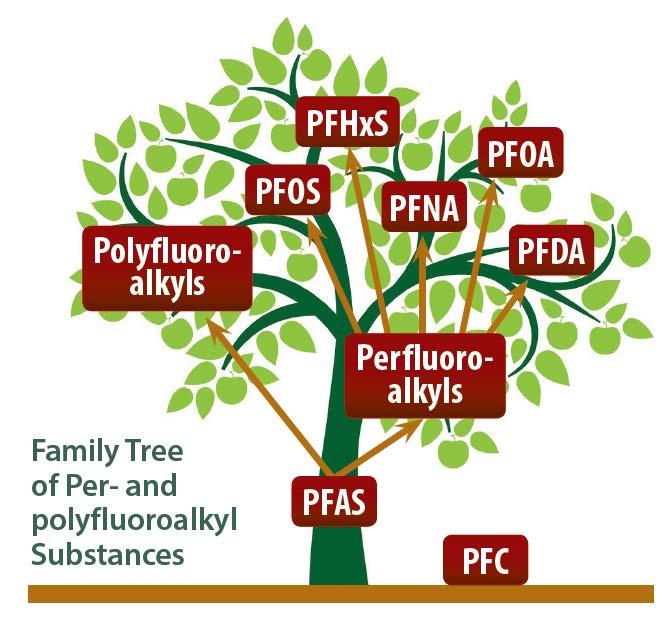
Per- and polyfluoroalkyl substances (PFAS) comprise a large and diverse class of synthetic chemicals, numbering in the thousands. Because of this diversity, scientists and regulators rely on multiple classification systems to better understand PFAS behavior, health risks, and regulatory challenges. No single classification fully captures the complexity of PFAS; instead, different approaches emphasize chemical structure, chain length, functional groups, usage patterns, or regulatory relevance.
Structural Classification: Perfluoroalkyl vs. Polyfluoroalkyl
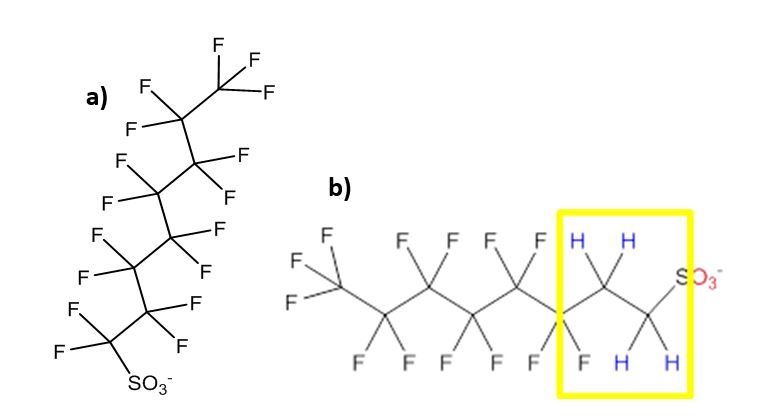
One of the most fundamental ways to classify PFAS is by the degree of fluorination along the carbon chain. Perfluoroalkyl substances are compounds in which all carbon atoms in the fluorinated chain are fully saturated with fluorine. This complete fluorination results in extremely strong carbon–fluorine bonds, making these chemicals highly persistent in the environment. Well-known examples include PFOS and PFOA.
In contrast, polyfluoroalkyl substances contain carbon chains that are only partially fluorinated. While these compounds may appear less stable, many can degrade or transform in the environment into perfluoroalkyl substances. As a result, polyfluoroalkyl compounds are not necessarily safer, even when marketed as replacements for legacy PFAS.
Source: Enviro WIKI
Classification by Carbon Chain Length
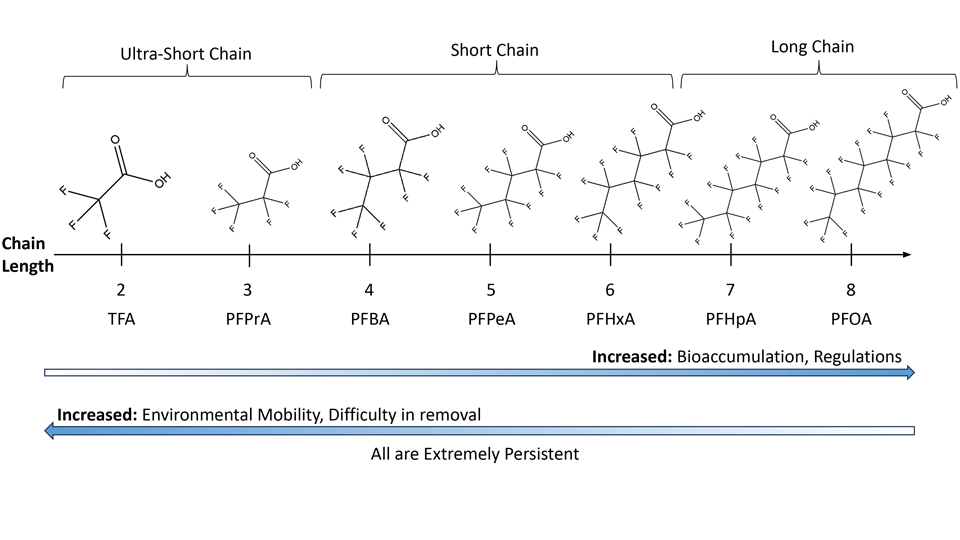
PFAS are also commonly grouped by carbon chain length, a distinction that has played an important role in regulation. Long-chain PFAS—generally defined as having six or more fully fluorinated carbons for sulfonates and eight or more for carboxylates—are associated with higher bioaccumulation and more extensive toxicological evidence. PFOS and PFOA fall into this category.
Short-chain PFAS were introduced as substitutes for long-chain compounds following voluntary phase-outs in the United States. These substances tend to accumulate less in human tissue but are often more mobile in water and more difficult to remove during drinking water treatment. Increasing evidence suggests that short-chain PFAS present their own environmental and regulatory challenges rather than a clear safety advantage.
Source: Aquagga, Inc.
Functional Group Classification
Another important classification system focuses on chemical functional groups. Perfluoroalkyl carboxylic acids (PFCAs) include PFAS with a carboxylic acid group and have been widely used in industrial applications and surface coatings.
Perfluoroalkyl sulfonic acids (PFSAs) contain a sulfonic acid group and are often associated with greater persistence and toxicity; PFOS is a prominent example. Functional group distinctions are particularly relevant for analytical detection and toxicological studies.
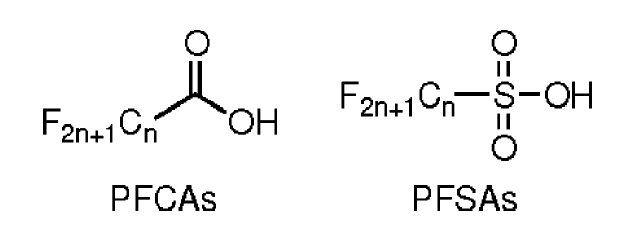
General structures of two PFAS classes: perfluorinated carboxylic acids (PFCAs) and sulfonic acids (PFSAs). Source: Rayne & Forest 2009.
Regulatory Definitions and Implications
Recognizing the limitations of regulating PFAS one substance at a time, agencies such as the Environmental Protection Agency and the Organisation for Economic Co-operation and Development increasingly apply broad definitions of PFAS, often encompassing any chemical containing at least one fully fluorinated carbon atom. These class-based approaches reflect growing recognition that PFAS diversity itself poses a fundamental regulatory challenge.
Summary
PFAS classification systems highlight both the chemical complexity of these substances and the difficulty of managing their risks. Understanding how PFAS are grouped—by structure, chain length, functional groups, use, and regulatory definitions—is essential for interpreting scientific research, evaluating health risks, and assessing emerging policy strategies.